Feminist Data as Resistance: Algorithmic Bias and Bodily Autonomy in Contemporary Media Art
DOI:
https://doi.org/10.25038/am.v0i28.639Keywords:
feminist resistance; anti-gender movements; media art; algorithmic bias; bodily autonomy; transnational solidarity.Abstract
This paper analyzes the intersection of feminist resistance and anti-gender movements within contemporary media art, with a specific focus on algorithmic bias and bodily autonomy. Through case studies and discourse analysis of three artworks, the paper highlights how the right-wing actors exploit technology to dismantle bodily autonomy through tools such as surveillance, reproductive monitoring and the digital weaponization of meme culture. The analysis addresses three core research questions: How do anti-gender actors exploit digital technologies to enforce oppressive gender norms? In what ways can feminist artworks function as counter-systems to algorithmic bias? What strategies enable effective transnational feminist resistance in digital spaces? Methodologically speaking, our study employs visual discourse analysis of three case studies: Caroline Sinders’ Feminist Data Set (algorithmic resistance), Mary Maggic’s Open Source Estrogen (biopolitical hacking), and @the.hormone.monster's meme activism (cultural subversion). Through these cases, the analysis reveals how feminist artists appropriate surveillance tools, medical technologies, and viral media to both expose systemic harms and prototype liberatory alternatives. The primary contribution lies in theorizing feminist media art as a dual-action resistance, simultaneously deconstructing oppressive technologies while building emancipatory infrastructures. The findings demonstrate that such artistic interventions offer concrete pathways to reclaim bodily autonomy from anti-gender techno-politics. The future of bodily autonomy lies in treating data as a tool for collective liberation, demonstrating how feminist media art can fuel large-scale resistance to anti-gender technologies.
References
Benjamin, Ruha. Race After Technology. Polity Press, 2019.
Blas, Zach. “Informatic Opacity.” Journal of Visual Culture 15, no. 3 (2016): 325–30.
Federici, Silvia. Caliban and the Witch: Women, the Body and Primitive Accumulation. Autonomedia, 2004.
Graff, Agnieszka, and Elżbieta Korolczuk. Anti-Gender Politics in the Populist Moment. Routledge, 2022. DOI: https://doi.org/10.4324/9781003133520
Halberstam, Jack. The Queer Art of Failure. Duke University Press, 2011. DOI: https://doi.org/10.2307/j.ctv11sn283
Haraway, Donna J. Staying with the Trouble: Making Kin in the Chthulucene. Duke University Press, 2016. DOI: https://doi.org/10.2307/j.ctv11cw25q
Maggic, Mary. Open Source Estrogen. 2015. Bioart project. https://maggic.ooo/Open-Source-Estrogen-1.
Noble, Safiya U. Algorithms of Oppression. New York: New York University Press, 2018.
Preciado, Paul B. Testo Junkie: Sex, Drugs, and Biopolitics in the Pharmacopornographic Era. Feminist Press, 2013.
Puar, Jasbir. The Right to Maim: Debility, Capacity, Disability. Duke University Press, 2017. DOI: https://doi.org/10.1215/9780822372530
Russell, Legacy. Glitch Feminism: A Manifesto. Verso Books, 2020.
Sinders, Caroline. Feminist Data Set. 2017. Digital art project. https://carolinesinders.com/feminist-data-set/.
Steyerl, Hito. The Wretched of the Screen. e-flux Journal, 2012.
Szuta, Marta. “Oświadczenie w sprawie aplikacji 'Moja Ciąża' jako narzędzia inwigilacji kobiet” [Statement regarding the 'My Pregnancy' app as a tool for surveilling women]. OKO.press, May 12, 2022. https://oko.press/app-moja-ciaza-inwigilacja.
Zuboff, Shoshana. The Age of Surveillance Capitalism. Public Affairs, 2019.
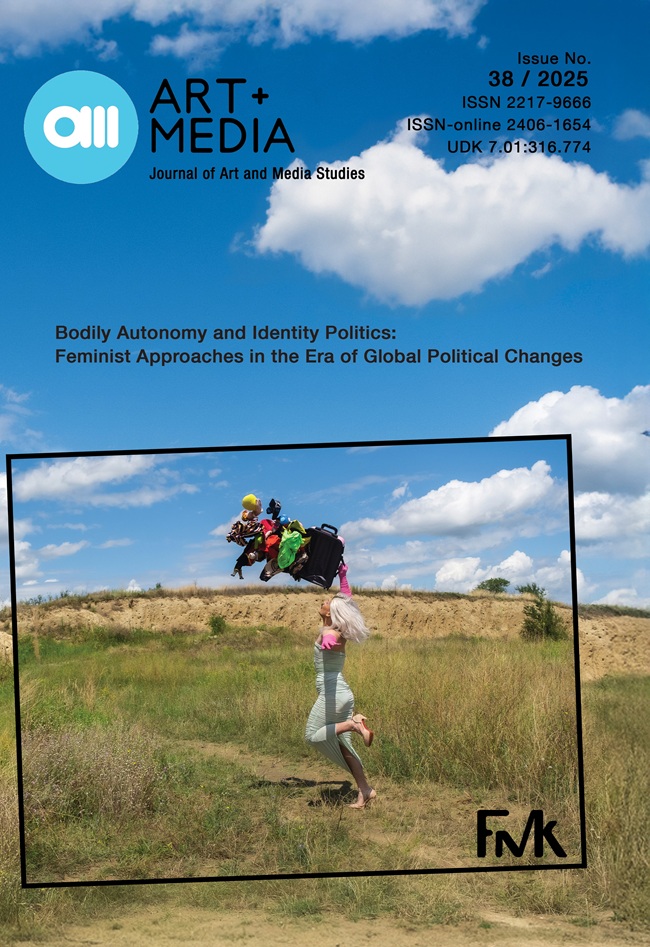
Downloads
Published
How to Cite
Issue
Section
License
Copyright (c) 2025 AM Journal of Art and Media Studies

This work is licensed under a Creative Commons Attribution-NonCommercial-NoDerivatives 4.0 International License.
The content on this site is licensed under a Creative Commons Attribution 4.0 International License.
AM Journal of Art and Media Studies ISSN 2217-9666 - printed, ISSN 2406-1654 - online, UDK 7.01:316.774
Contact: amjournal@outlook.com
Publisher: Faculty of Media and Communications, Singidunum University, Belgrade, Serbia
Indexed in: ERIH PLUS, EBSCO, DOAJ, and in The List of Scientific Journals Categorization of Ministry of Education, Science and Technological Development of Republic of Serbia (M24 in 2021; M23 in 2023; M22 in 2025). Beginning with No. 12 2017, AM is indexed, abstracted and covered in Clarivate Analytics service ESCI.