Empathy as an Aesthetic Infrastructure of Intercultural Communication: China and Post-Yugoslav Digital Narratives in the Age of AI
DOI:
https://doi.org/10.25038/am.v0i28.675Keywords:
empathy; aesthetics; affect; intercultural communication; artificial intelligence; digital media; globalization; China; post-Yugoslav space.Abstract
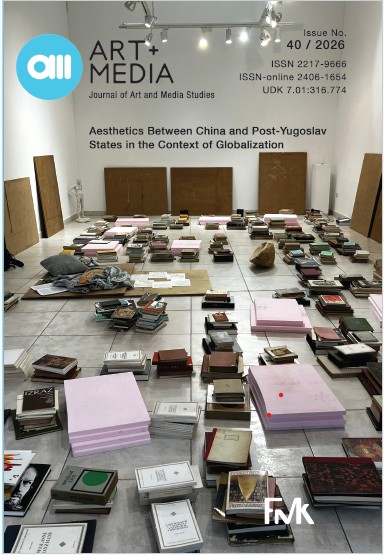
This article examines intercultural communication between China and the post-Yugoslav states in the context of globalization and the emergence of artificial intelligence (AI), proposing empathy as a central yet ambivalent aesthetic infrastructure through which cultural difference is mediated. While digital platforms and AI technologies have dramatically increased the intensity and visibility of cross-cultural encounters, they have also transformed the conditions under which cultures are perceived, felt, and understood. Drawing on continental philosophy, moral psychology, and communication theory—particularly the work of Jean-Luc Nancy, Maurice Blanchot, Zygmunt Bauman, Martin Hoffman, and Jürgen Habermas—this study conceptualizes empathy not merely as a psychological or ethical capacity, but as an aesthetic and communicative form shaped by media technologies. Drawing on a theoretical-comparative and interpretative approach, the article examines Chinese and post-Yugoslav affective and aesthetic regimes as they are represented, circulated, and emotionally experienced within contemporary digital environments. Chinese culture is globally circulated through narratives of harmony, technological progress, and collective futurity, while post-Yugoslav cultures are framed through trauma, nostalgia, and emotional authenticity. These representations invite empathic engagement, yet often at the cost of historical depth, internal plurality, and ethical responsibility. The article argues that AI-driven empathy produces emotional proximity without genuine dialogue, replacing communicative understanding with affective optimization. In response, it proposes a critical aesthetics of empathic communication that preserves distance, opacity, and interpretive labor as necessary conditions for meaningful intercultural dialogue. Such an approach is essential for rethinking cultural exchange between China and the post-Yugoslav space in the age of artificial intelligence.
References
Ahmed, Sara. The Cultural Politics of Emotion. Edinburgh University Press, 2004.
Bakić-Hayden, Milica. “Nesting Orientalisms: The Case of Former Yugoslavia.” Slavic Review 54, no. 4 (1995): 917–931.
Bauman, Zygmunt. Liquid Modernity. Polity Press, 2000.
Blanchot, Maurice. The Unavowable Community. Translated by Pierre Joris. Station Hill Press, 1988.
Boym, Svetlana. The Future of Nostalgia. Basic Books, 2001.
Buden, Boris. Zone des Übergangs: Vom Ende des Postkommunismus. Suhrkamp, 2009.
Chow, Rey. Sentimental Fabulations, Contemporary Chinese Films: Attachment in the Age of Global Visibility. Columbia University Press, 2007.
Habermas, Jürgen. The Theory of Communicative Action, Volume 1: Reason and the Rationalization of Society. Translated by Thomas McCarthy. Beacon Press, 1984.
Han, Byung-Chul. The Burnout Society. Translated by Erik Butler. Stanford University Press, 2015.
Hoffman, Martin L. Empathy and Moral Development: Implications for Caring and Justice. Cambridge University Press, 2000.
Hui, Yuk. The Question Concerning Technology in China: An Essay in Cosmotechnics. Urbanomic and Sequence Press, 2016.
Massumi, Brian. Parables for the Virtual: Movement, Affect, Sensation. Duke University Press, 2002.
Nancy, Jean-Luc. The Inoperative Community. Edited by Peter Connor. University of Minnesota Press, 1991.
Papacharissi, Zizi. Affective Publics: Sentiment, Technology, and Politics. Oxford University Press, 2015.
Todorova, Maria. Imagining the Balkans. Oxford University Press, 1997.
Zhang, Zhen. An Amorous History of the Silver Screen: Shanghai Cinema, 1896–1937. University of Chicago Press, 2005.
Downloads
Published
How to Cite
Issue
Section
License
Copyright (c) 2026 AM Journal of Art and Media Studies

This work is licensed under a Creative Commons Attribution-NonCommercial-NoDerivatives 4.0 International License.
The content on this site is licensed under a Creative Commons Attribution 4.0 International License.
AM Journal of Art and Media Studies ISSN 2217-9666 - printed, ISSN 2406-1654 - online, UDK 7.01:316.774
Contact: amjournal@outlook.com
Publisher: Faculty of Media and Communications, Singidunum University, Belgrade, Serbia
Indexed in: ERIH PLUS, EBSCO, DOAJ, and in The List of Scientific Journals Categorization of Ministry of Education, Science and Technological Development of Republic of Serbia (M24 in 2021; M23 in 2023; M22 in 2025). Beginning with No. 12 2017, AM is indexed, abstracted and covered in Clarivate Analytics service ESCI.