Editors’ Note
The connection between China and the post-Yugoslav countries has become more significant in the 21st century. Growing political, economic, and cultural interactions have opened new avenues for dialogue. Meanwhile, globalization and artificial intelligence have drastically changed how aesthetic concepts, artistic methods, and cultural stories spread across different nations and languages. However, as this special issue shows, these interactions are not just about increasing connections. They call for ongoing historical analysis, critical comparisons, and an awareness of the unique cultural paths that shape, translate, and reinterpret aesthetic traditions.
This collection of articles in the Main Topic section examines these questions through diverse disciplinary lenses, including art history, architecture, media studies, communication theory, film studies, and digital aesthetics. Instead of focusing on a single narrative of exchange, they highlight various connections between Chinese and post-Yugoslav contexts: shared histories of modernity, similar responses to globalization, the movement of artistic styles across different media, and emerging technological conditions that alter perception, communication, and cultural identity.
The issue begins with two studies that lay the broad historical and conceptual groundwork for intercultural dialogue. Limei Gou and Jinyao Zhang reframe Constructivism as a visual logic that moved across Chinese left-wing print culture and Yugoslav Zenithism, challenging traditional views on stylistic influence and highlighting the dynamic movement of visual forms. Next, Tamara Koneska explores socialist modernism in Yugoslavia, focusing on Kockica to show how architecture and art served together as tools of ideological and aesthetic expression within the country’s cultural politics.
These contributions highlight current artistic and media practices. Ana Frangovska offers a comparative analysis of contemporary art in China and North Macedonia, illustrating how artists in different institutional settings address shared themes like memory, identity, and visual language. Caishu Zhou explores the Chinese film industry as a “new media spectacle”, asserting that cinema now plays a key role in how contemporary Chinese culture engages with industrialization, urban development, cultural heritage, and aesthetic education.
The last two articles explore how digital technologies impact modern aesthetics and intercultural dialogue. Tamara Bradić analyzes China’s Social Credit experiments alongside educational data systems in Serbia, viewing both as aesthetic frameworks that shape visibility, classification, and identity within digital governance. In the final part, Simona Žikić suggests empathy as an aesthetic infrastructure for intercultural communication, emphasizing that artificial intelligence increasingly mediates not just the flow of information but also the emotional contexts that make cultures visible and understandable to each other.
These contributions show that the dialogue between China and the post-Yugoslav states is more than just about influence or comparison. They highlight a dynamic field where historical memory, modernist legacies, current artistic practices, digital infrastructures, and emerging AI forms constantly reshape aesthetic experience. Consequently, this discussion adds to global aesthetics debates by emphasizing that meaningful intercultural exchange relies not on erasing differences, but on critically examining the media, institutions, and aesthetic forms that make differences perceptible, communicable, and dialogue ready.
Guest issue editors
Dr. Zhang Chenghua, South China Normal University, China
Dr. Fu Qilin, Sichuan University, China
Zhang Chenghua, PhD, Associate Professor at the School of Chinese Language and Literature, South China Normal University, and Director of the Editorial Department of Aesthetic Cultural Studies, has published books including Australian Cultural Studies: Issues, Dimensions, and Reflections (2022), and Research on Yugoslav Marxist Literary and Artistic Theory (2025).
Fu Qilin is a Doctor of Literature and Professor at the College of Chinese Language and Literature in Sichuan University of China, Chief Expert of a key project of the China Social Science Fund “Bibliography and Research of Eastern European Marxist Aesthetics” (15ZDB022) and the China Ministry of Education key project of philosophy and social sciences “Chinese Marxist Aesthetics for a Hundred Years and its Theoretical Construction” (2025JZD006). Fu Qilin’s published books include: A Study of Agnes Heller’s Thoughts on Aesthetic Modernity (2006), An Anthropological Interpretation of Aesthetic Ideology (2008), and The Critique of Grand Narrative and the Construction of Pluralist Aesthetics: A Study of Reconstructing Aesthetics of Budapest School (2011), A Study of basic issues of Eastern European Neo-Marxist Literary and Artistic Theory (2017), Janus Face: selected works of Agnes Heller's aesthetics (2020), The Normative Foundation of the Contemporary Literary Theory (2024); Marxist Aesthetics on Eastern Europe(2025), etc.
Reviewers: Tamara D. Bradić (Faculty of Media and Communications, Singidunum University, Belgrade, Serbia), Julen Alexandre Carreño Aguado (Valencia Catholic University Saint Vincent Martyr, Valencia, Spain), Limei Gou (Communication University of China, Beijing; School of Foreign Languages, Lanzhou University of Arts and Science, China), Tamara Koneska (Faculty of Architecture, University of Belgrade, Serbia), Daniela Licandro (School of Humanities, Tallinn University, Estonia), Wen Ma (School of Journalism and Communication, Nanjing University, Nanjing, China), Danica Milan Stojiljković (University of Belgrade, Institute for Multidisciplinary Research, National Institute of the Republic of Serbia), Vesna Perković Jović (Faculty of Civil Engineering, Architecture and Geodesy, University of Split, Croatia), Marko Špikić (Faculty of Humanities and Social Sciences, University of Zagreb, Croatia), Simona Žikić (Institute for Philosophy and Social Theory, University of Belgrade; Faculty of Media and Communications, Singidunum University, Serbia)
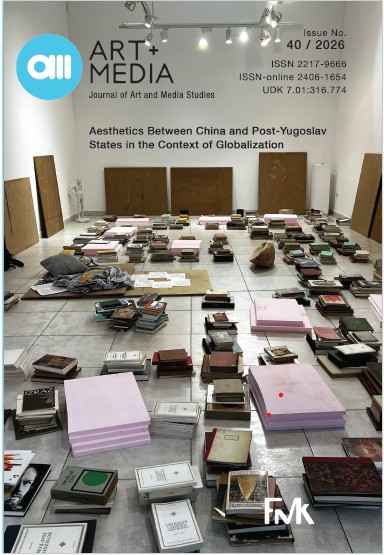
On the cover: Exhibition view. Žarko Aleksić, Òбразовање и Образовáње, FLU Gallery,
Belgrade, 2026. Photographs by Danilo Bursać.